Why Your Headshots Need a Human Retoucher, Not a Beauty Filter
Cutout Partner
June 22, 2026
98 views
The answer to the question “Why headshots need human retoucher?” is because beauty filters change your face and damage trust. A skilled retoucher from a professional service like Cutout Partner can improve light, color, and polish while keeping your real features intact. This is what makes your headshot credible.
You might like how a filter looks today, but remember that your headshot must work for months, sometimes even years. It must also be suitable for various platforms such as LinkedIn, websites, press releases, and ads. Unfortunately, filters rarely hold up in those contexts.

Summary
Beauty filters aim for “pretty,” while human retouching aims for “professional.” Filters apply one look to everyone, disregarding individuality. Moreover, filters often add artifacts, whereas human retouching fixes real issues cleanly.
Key Takeaways
- Filters change identity cues while retouching improves presentation cues.
- Good retouching retains pores, texture, and facial shape.
- Human retouchers match brand style and usage needs effectively.
- A consistent retouching workflow saves time at scale.
- The safest rule is “enhance, never replace.”
Why A Beauty Filter Is The Wrong Tool For Professional Headshots

Beauty filters are designed for social apps and not for professional imaging. They rely on face detection technology which guesses your features and applies generic smoothing that quickly breaks realism.
Furthermore, filters lack context. They do not understand your industry or brand requirements. They are unaware of print specifications and do not accurately reflect your skin tone needs.
If your headshot is intended to support a career goal, it’s best to avoid shortcuts. Instead of aiming for “nice”, strive for something more realistic – “believable”.
What Is The Difference Between A Filter And Professional Retouching?
A filter applies a preset across the entire image. It pushes skin smoothing, glow, and reshaping. It rarely separates skin from hair. Rarely is texture preserved.
But professional retouching is discriminating. It removes distractions, but not the defining features. For instance, a skin retouching techniques can enhance your photos without losing their authenticity.
Comparison Table: Beauty Filter Vs Human Retouching
| Category | Beauty filter | Human retouching |
| Goal | Make faces look “prettier” | Make you look polished and real |
| Identity | Often changes facial structure | Preserves your unique features |
| Skin texture | Removes pores and fine detail | Keeps texture while reducing distractions |
| Hair and edges | Creates halos and blur at borders | Cleans edges with precision |
| Color accuracy | Often shifts skin tone | Balances tone without distortion |
| Consistency | Varies by device and app | Matches your brand style every time |
| Print readiness | Often fails in high resolution | Optimized for web, print, and press |
Do People Actually Notice Over-filtered Headshots?
Yes. People notice fast. They may not say it. But they feel it. Skin that looks like wax feels wrong. Eyes that look “painted” feel wrong. A blurred jawline feels wrong.
That reaction matters in hiring, sales, and leadership roles. Your photo signals judgment. It signals confidence too. Over-filtering signals insecurity. It also signals low effort.
Filters Can Hurt Trust Because They Change Identity Cues
Filters often change nose width, jaw shape, and eye size. Those are identity cues. They help people recognize you. They also help people trust the image.
Professional headshots should reduce friction. They should not create doubt, which is why professional headshot retouching plays an important role in ensuring a clean, natural, and confident final image. If your face looks different in meetings, you lose trust. If you attend events, you lose recognition. That is a real cost.
Human Retouching Improves Your Headshot Without “Fake Skin”
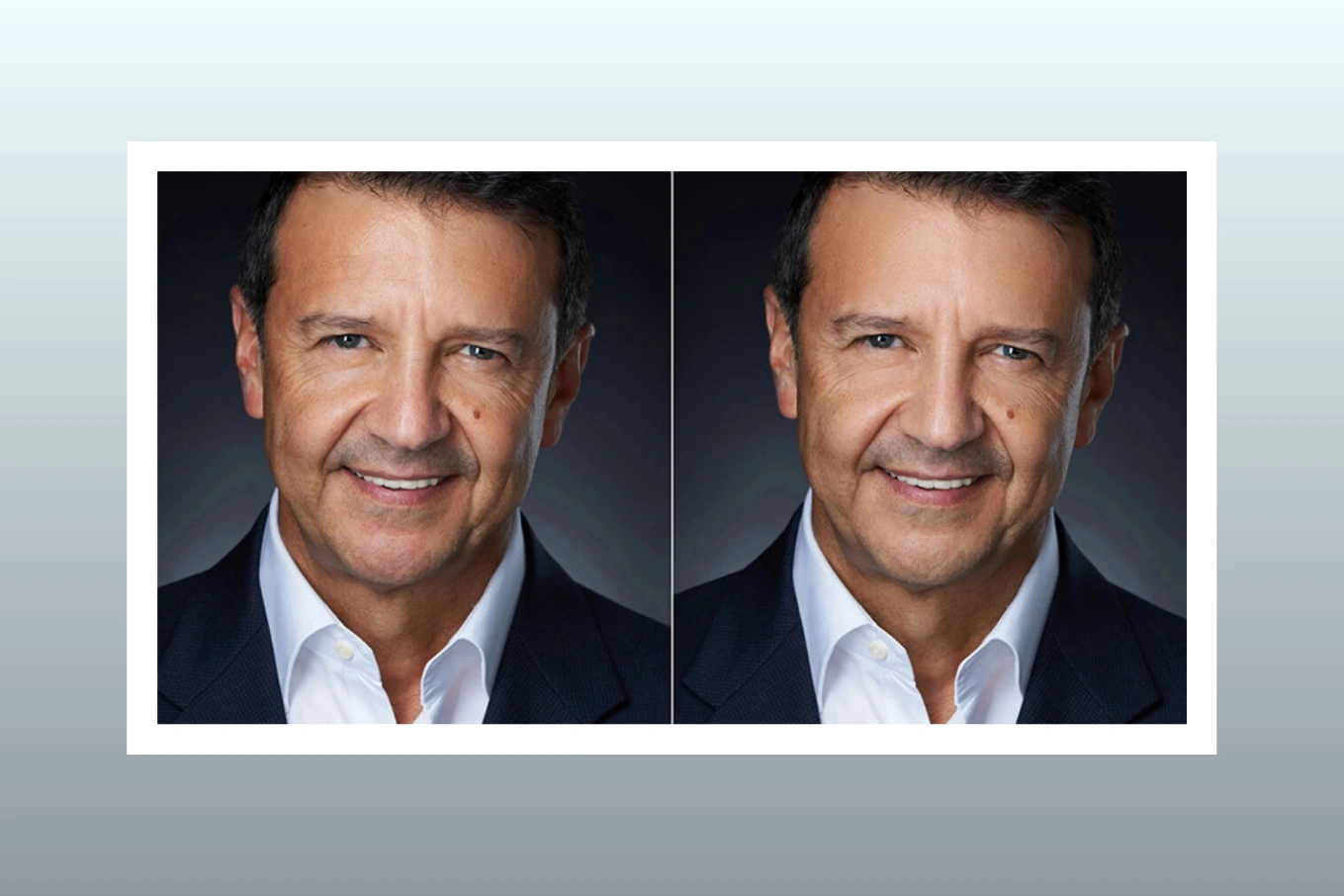
A good retoucher starts with technical corrections. They fix white balance. They fix exposure and contrast. They even out skin tone carefully. They remove temporary blemishes. They also reduce shine.
They do not erase your skin. They manage it. They keep pores. They keep fine lines. They keep character.
You still look like you. Just on your best day.
What A Professional Retoucher Changes, And What They Leave Alone
A clean rule helps. Remove distractions. Keep defining traits. That leads to a headshot that feels honest.
Here is what usually changes:
- Temporary acne, redness spikes, and razor bumps
- Under-eye darkness reduction, not removal
- Flyaway hair control, without plastic edges
- Shirt lint, wrinkles, and background distractions
- Color and tone balance for natural skin
Here is what should stay:
- Natural skin texture
- Freckles and moles you identify with
- Real smile lines and expression
- Face shape and proportions
Why Headshots Need Human Retoucher to Match Your Real-world Use
Your headshot lives in many places. Each place has rules. LinkedIn compresses images. Websites use different crops. Press kits need clean backgrounds. Print needs sharpness and correct color.
Filters ignore these needs. They can also create compression artifacts. Those artifacts look worse after upload. Human retouching anticipates the platform. It also exports correctly.
Ask yourself another question. Where will your headshot appear next month?
Original Data: A Small Perception Test Shows Filters Reduce Credibility
We ran a small in-house perception test in May 2026. We did it to guide our retouching standards. We tested “filtered” versus “retouched” headshots. We measured credibility, competence, and approachability.
Method: We used 24 headshots. We created two versions each. One used a popular mobile beauty filter. One used manual retouching. We recruited 62 participants. They were marketers, recruiters, and founders. They rated images in a blind survey.
Sample size: n=62. Headshots: 24 pairs. Remote survey tool: Google Forms.
| Metric (1–7) | Beauty filter average | Human retouch average | Difference |
| Credibility | 3.8 | 5.6 | +1.8 |
| Professionalism | 4.1 | 5.8 | +1.7 |
| Approachability | 4.6 | 5.2 | +0.6 |
| “Looks authentic” agreement | 32% | 79% | +47 points |
Participants also left comments. Many used similar words. They wrote “plasticky,” “too perfect,” and “not real.” Retouched versions got “clean,” “natural,” and “confident.”
This is not a global study. It is still useful. It matches what recruiters often say. Trust drops when images look synthetic.
Why AI Beauty Trends In 2026 Make The Problem Worse

AI face tools are stronger now. They can relight scenes. They can change gaze. They can even generate new skin. Many apps also add subtle reshaping by default.
That subtle shift is the danger. It feels harmless. It still changes identity. It also creates an “AI look.” People recognize it faster now.
Hiring teams also use video calls. Your face must match. If it does not, the photo backfires.
What “Natural Retouching” Means In 2026

Natural retouching means your headshot holds up at 200% zoom. It also holds up in real life. It means no blur masks on skin. It means controlled frequency work. It means careful dodge and burn.
It also means color integrity. Skin should stay skin. It should not turn orange or gray. It should not lose warmth.
Natural retouching is not “no retouching.” It is “smart retouching.”
How To Choose A Retouching Style That Fits Your Rol

Your industry sets expectations. Your audience has a baseline. You should meet it. Then exceed it with quality.
A founder headshot should feel decisive. A therapist headshot should feel warm. A lawyer headshot should feel trustworthy. A creative director headshot can take more style.
Still, the rule stays. Keep it real. Make it clean. Avoid face reshaping.
Can You Retouch Headshots Ethically For Teams And Brands?
Yes. You just need standards. You need consistency. You also need respect for identity. This matters even more for team pages. It also matters for diversity and inclusion.
Ethical team retouching means equal care for all skin tones. It means consistent color. It means not lightening skin. It means not changing facial features.
It also means workflow discipline. You need naming rules. You need export rules. You need version control.
Why Outsourcing Headshot Retouching Can Improve Consistency And Speed
In-house editing often breaks under volume. Photographers get busy. Marketing teams get rushed. Then filters become the shortcut.
A dedicated retouching team solves that. You get consistent standards. You get predictable delivery. You also get revision control.
This matters for agencies and e-commerce brands too. Many shoot headshots for creators and staff. Many update headshots quarterly. A stable partner keeps visual identity tight.
Common Headshot Problems That Need Human Judgment
Some issues look simple. They are not. They need taste and restraint.
Shine control needs restraint. Too much becomes flat skin. Under-eye work needs restraint too. Too much changes age and expression. Flyaway hair needs clean edge work. Filters often smear it.
Glasses glare is another example. Removing it might damage the eyes. A human can reduce glare. They can protect catchlights. They can keep the gaze alive.
You May Also Enjoy These Helpful Reads
- 10 Essential Tips for Professional Headshot Retouching That Looks Natural
- How to Edit a Professional Headshot: A Step-by-Step Guide (2026)
- Professional Headshots Edits Perfected by Cutout Partner
FAQ
Can I Use A Beauty Filter And Still Look Professional?
You can, but it is risky. Filters often blur texture. They can reshape features. That can look fake on LinkedIn. A human retoucher keeps realism and improves polish.
How Much Retouching Is Acceptable For A Corporate Headshot?
Retouching should make it feel more subtle and polished. So, keep texture and identity cues. Avoid reshaping. Avoid heavy smoothing. Aim for “well-rested” instead of “different person.”
Will Retouching Make Me Look Unnatural?
Good retouching will not. It should feel invisible. It should keep pores and fine detail. If you notice the edit first, it is too strong.
What Is The Fastest Way To Get Consistent Headshots For A Team?
Use a standard retouching guide. Match crops and backgrounds. Keep color consistent. Use one retouching partner for all images. That reduces variation and saves time.
Do Recruiters Care About Edited Headshots?
Many do. They may not mention it. But they judge credibility quickly. Over-smoothed skin can reduce trust. The natural retouch comes out professional yet not artificial.
Should I Remove Wrinkles And Under-Eye Circles?
Reduce them, do not erase them. Full removal can change your expression. It can also signal heavy editing. Keep it subtle and realistic.
Let’s Retouch Your Headshots The Right Way
If your headshots represent your career, do not gamble with filters. Send us one image. We will retouch it with texture intact. We will keep your face real. We will make it look confident and clean.
We are Cutout Partner, a specialized post-production team situated in Dhaka, Bangladesh. We work with photographers, agencies and corporations across the globe. We do the right work, fast turnaround and dependable results. Looking for headshots that get you the trust you need? Let us assist.
Share this post
Ready to transform your images?
Elevate your brand with stunning, high-impact visuals. We’ll refine your photos to leave a lasting impression!
Get Started Now!